
Who were the brothers of Jesus, and why are they so often overlooked? In this episode, we uncover the complete story of James, Joses, Judas, and Simon - the men who grew up in the same home as Jesus, doubted Him during His ministry, and were later transformed into bold leaders of the early church. From family tension and unbelief to resurrection faith, martyrdom, and legacy, this is the story of the brothers of Jesus like you’ve never seen it before. The people of Nazareth were shocked when Jesus began His ministry, asking, "Is not this the carpenter, the son of Mary and brother of James and Joses and Judas and Simon? And are not his sisters here with us?" (Mark 6:3) Despite their shared life in Nazareth, the scriptures reveal a difficult family dynamic during Jesus' earthly ministry, noting, "For not even his brothers believed in him." (John 7:5) The tension grew so great that at one point His family even tried to physically stop Him from preaching, because "when his family heard it, they went out to seize him, for they were saying, 'He is out of his mind.'" (Mark 3:21) Everything changed when the risen Christ appeared to His family. Paul records this turning point, writing, "Then he appeared to James, then to all the apostles." (1 Corinthians 15:7) This encounter led the brothers into the heart of the movement, where they were found praying alongside the disciples: "All these with one accord were devoting themselves to prayer, together with the women and Mary the mother of Jesus, and his brothers." (Acts 1:14) James soon rose to become a pillar of the faith in Jerusalem. When Paul visited the city, he noted, "But I saw none of the other apostles except James the Lord’s brother." (Galatians 1:19) During the critical Council of Jerusalem, it was James who gave the final ruling on how to welcome non-Jewish believers, stating, "Therefore, my judgment is that we should not trouble those of the Gentiles who turn to God." (Acts 15:19) James’s authority was so significant that even the Apostle Peter was swayed by his influence during a conflict in Antioch, as Paul observed, "For before certain men came from James, he was eating with the Gentiles; but when they came he drew back and separated himself, fearing the circumcision party." (Galatians 2:12) In his own letter, James emphasized a practical, active faith, urging believers, "But be doers of the word, and not hearers only, deceiving yourselves." (James 1:22) He famously challenged those who claimed faith without action, writing, "For as the body apart from the spirit is dead, so also faith apart from works is dead." (James 2:26) The brother Jude also contributed to the New Testament, though he identified himself with great humility: "Jude, a servant of Jesus Christ and brother of James." (Jude 1:1) Jude’s writing was urgent and protective, calling on the church to "contend for the faith that was once for all delivered to the saints." (Jude 1:3) His letter is known for its vivid and unique references, including a cosmic struggle: "But when the archangel Michael, contending with the devil, was disputing about the body of Moses, he did not presume to pronounce a blasphemous judgment, but said, 'The Lord rebuke you.'" (Jude 1:9) Jude even cited ancient prophecies to warn against false teachers, noting, "It was also about these that Enoch, the seventh from Adam, prophesied, saying, 'Behold, the Lord came with ten thousands of his holy ones, to execute judgment on all and to convict all the ungodly...'" (Jude 1:14-15) Finally, Jude closed his message with one of the most famous prayers in all of scripture: "Now to him, who is able to keep you from stumbling, and to present you blameless before the presence of his glory with great joy..." (Jude 1:24)

More in Stories of Bible Characters
 33 min
Stories of Bible Characters
Why Wasn't AARON EXECUTED With The 3,000 Who Made The Golden Calf?
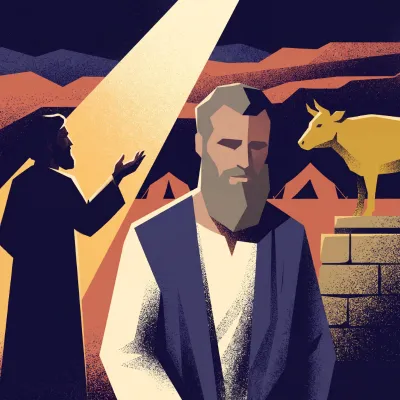
The Levites moved through the camp of Israel with swords in their hands, and by sundown three thousand people were dead. They walked past tent after tent, and at some point they walked past the one man who had melted the gold, shaped the idol with his own tool, built an altar before it, and announced the feast. They walked past Aaron, and not one sword touched him. Within months, the man who made the golden calf was standing before God in holy garments as the first high priest of Israel. How can that be right? Why was Aaron spared when three thousand others were not? In this episode, we explore the real answer the Bible gives, hidden in a single verse Moses did not speak until forty years later. We feel the fear and impatience at the foot of Sinai, look honestly at the full weight of Aaron's sin, and see that God's first sentence was against the whole nation. We discover that the Lord was angry enough with Aaron to destroy him, and that Aaron lived because Moses prayed for him by name. We also follow Moses as he "stood in the breach" and offered to be blotted out of God's book for the people, and why God refused. We trace Aaron's life after the calf: the sin offering for himself at his ordination, his failures with Miriam and at Meribah, and his death on Mount Hor. And we see how his story points to the one Mediator whose offer heaven did not refuse. Bible verses included in this episode: “Whoever is for the Lord, come to me.” (Exodus 32:26) “And the Lord was angry enough with Aaron to destroy him, but at that time I prayed for Aaron too.” (Deuteronomy 9:20) “Had not Moses, his chosen one, stood in the breach before him to keep his wrath from destroying them.” (Psalm 106:23) “But if not, then blot me out of the book you have written.” (Exodus 32:32) “Therefore he is able to save completely those who come to God through him, because he always lives to intercede for them.” (Hebrews 7:25) If you have failed under pressure and wondered whether God could ever use you again, look at what He did with Aaron. God's callings are not reserved for people with clean histories. They are given to forgiven people. Aaron did not know Moses was praying for him. If you belong to Jesus, He always lives to intercede for you. The sentence has already fallen on Him, and the God who kept a place for the man who made the golden calf has kept a place for you.
 32 min
Stories of Bible Characters
Why Is There No Tribe Of Joseph In Israel? The Shocking Reason Explained
There is a name missing from the map of Israel, and it belongs to the one man who made the map possible. Joseph, the favorite son and the dreamer who saved his whole family from famine, has no territory named after him when Joshua divides the promised land among the tribes. It can look like an oversight, or even an insult. But Joseph's name is not missing because he received too little. It is missing because he received too much to fit inside a single border. In this episode, we explore the surprising reason there is no tribe of Joseph. We look at the birthright and double portion of the firstborn, how Reuben lost it, and how it passed to Joseph. We step into a dim room in Egypt where the dying Jacob adopts Joseph's two sons, Ephraim and Manasseh, as his own, and then crosses his arms to bless the younger above the older, redeeming the deception of his own youth. We see why the count of the tribes still stays at twelve because Levi's inheritance was the Lord Himself, and why two boys with an Egyptian mother became the model of blessing for generations. We also trace Joseph's name through the rest of Scripture, from Shiloh and the Psalms to Ezekiel's "two portions" and the tribe of Joseph in Revelation 7, and see how Joseph's story points to Jesus, the beloved Son whose reward is children adopted into God's family. Bible verses included in this episode: “He was the firstborn, but because he defiled his father’s bed, his birthright was given to the sons of Joseph.” (1 Chronicles 5:1) “And now your two sons, Ephraim and Manasseh, who were born to you in the land of Egypt before I came to you in Egypt, are mine; as Reuben and Simeon, they shall be mine.” (Genesis 48:5) “I know, my son, I know. He also shall become a people, and he also shall be great; but truly his younger brother shall be greater than he.” (Genesis 48:19) “By you Israel will bless, saying, ‘May God make you as Ephraim and as Manasseh!’” (Genesis 48:20) “The Lord is his inheritance.” (Deuteronomy 10:9) “Give ear, O Shepherd of Israel, You who lead Joseph like a flock.” (Psalm 80:1) “Joseph shall have two portions.” (Ezekiel 47:13) “But as many as received Him, to them He gave the right to become children of God.” (John 1:12) If you feel overlooked, left off the lists, or wonder whether your background disqualifies you, let Joseph's story stand as a witness. The people the world can no longer find on its lists are often the ones God has recorded most carefully. The God who never forgot Joseph has not forgotten you. The double portion always comes after the pit.
 32 min
Stories of Bible Characters
The Fall of Lucifer: How the Most Beautiful Angel Became Satan
The most beautiful angel who ever existed did not become Satan because he was tricked, wounded, or forced. He fell because of what happened quietly inside his own heart. A creature who stood closer to God than almost anything ever made looked at his beauty, his wisdom, and his nearness to the throne, and decided it was not enough. He wanted to be like God instead of loving God. If you have ever felt far from God, unworthy, tired, or ashamed of your own heart, this story is for you. The one who fell was not far from God when he fell. He was near. And that tells us that nearness alone is not what keeps us safe. In this episode, we explore the fall of Lucifer, gathering the pieces Scripture gives us in Isaiah 14 and Ezekiel 28. We look at where the name Lucifer comes from, how high this anointed guardian once stood, and how pride grew in secret until it became rebellion. We follow him from heaven to the garden of Eden, where he offered the same lie that ruined him, and we see what he truly lost. Not a battle, which he could never win, but nearness to God. Then the story turns from warning to good news. Where Lucifer, a creature, reached up to seize God's place, Jesus, who truly is God, came down, humbled Himself, and went to the cross for us. The title the fallen angel lost, the morning star, now belongs to Christ. Bible verses included in this episode: “How you have fallen from heaven, morning star, son of the dawn!” (Isaiah 14:12) “Your heart became proud on account of your beauty, and you corrupted your wisdom because of your splendor.” (Ezekiel 28:17) “You said in your heart, ‘I will ascend to the heavens, I will raise my throne above the stars of God... I will make myself like the Most High.’” (Isaiah 14:13–14) “Become conceited and fall under the same judgment as the devil.” (1 Timothy 3:6) “I saw Satan fall like lightning from heaven.” (Luke 10:18) “The great dragon was thrown down, that ancient serpent, who is called the devil and Satan, the deceiver of the whole world.” (Revelation 12:9) “I am the bright Morning Star.” (Revelation 22:16) You are not shut out because you are weak. Weakness is not what brought down the morning star. Pride is. The nearness he threw away is offered back to you freely in Jesus Christ. Not earned. Not deserved. Given. The morning star fell reaching upward. You can be lifted up simply by kneeling down. Come low, come honest, come as you are.
 31 min
Stories of Bible Characters
The Untold Truth About Methuselah, Enoch and Noah: Why God Waited for Him
Enoch walked so closely with God that he never tasted death. Noah built a boat on dry land and carried his family safely over a drowning world. And between them stands Methuselah, the man who lived longer than anyone who has ever drawn breath. He left behind no sermon and no miracle, only a name and a number so large it barely feels real. Yet Methuselah was the man God waited for. Every year he stayed alive, the flood held back. Every morning he woke, the judgment the world had already earned was pushed one more day into the future. His long life was the longest stretch of patience God ever held over a world that had run out of reasons to be spared. In this episode, we explore the story of Methuselah, Enoch, and Noah together. We step into a world filled with violence and corruption, meet Enoch, the father who walked with God until God took him, and consider what it meant for Methuselah to live 969 years, burying generation after generation while he watched faith itself fade. We see how God was quietly at work inside the long wait, raising up Noah, a man who found favor in His eyes before he ever cut a single plank for the ark. These three men, one family, show the shape of the gospel in miniature. God guards His promise, and He prepares a way of rescue before the storm ever breaks. Bible verses included in this episode: “Enoch walked faithfully with God; then he was no more, because God took him away.” (Genesis 5:24) “Altogether, Methuselah lived a total of 969 years, and then he died.” (Genesis 5:27) “He will comfort us in the labor and painful toil of our hands caused by the ground the Lord has cursed.” (Genesis 5:29) “But Noah found favor in the eyes of the Lord.” (Genesis 6:8) “The Lord is not slow in keeping his promise, as some understand slowness. Instead he is patient with you, not wanting anyone to perish, but everyone to come to repentance.” (2 Peter 3:9) If you have prayed the same prayer for years and heaven has felt silent, a long wait is not proof that God has forgotten you. Very often, the wait is where God is doing His deepest and quietest work. You are not too far behind, and you are not too late. The patience that held back a flood is patient enough to wait for you to take one small step toward home. The door is still open.